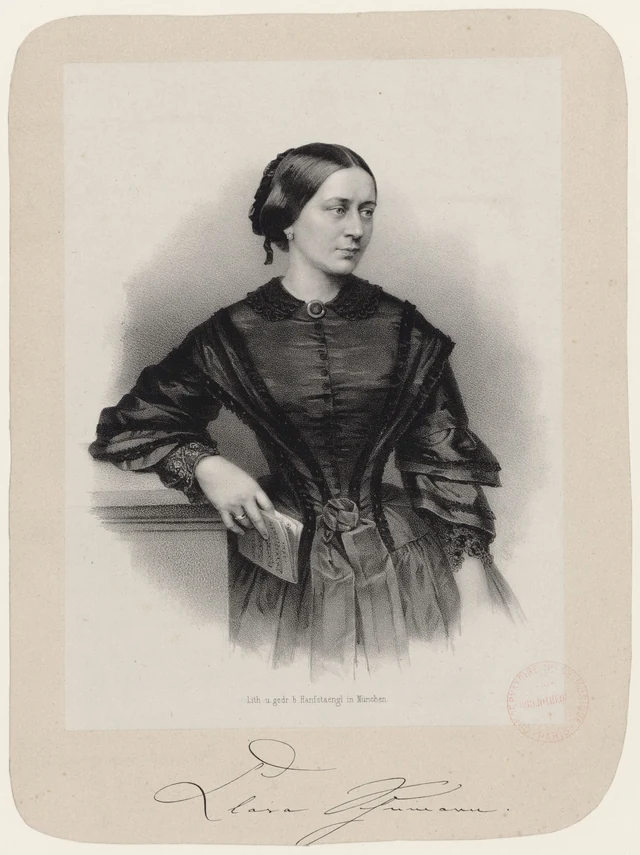
Clara Schumann built a musical life across composition, performance, teaching, and editing. Born Clara Josephine Wieck in Leipzig in 1819, she became an internationally active pianist while still young. Her later reputation as an interpreter should not obscure the creative work she undertook herself: her catalogue reaches from intimate piano pieces and songs to a concerto and a substantial piano trio.[2][3]
Her father, the piano teacher Friedrich Wieck, directed her early training. She appeared at the Leipzig Gewandhaus in 1828 and began travelling beyond Germany as a young performer. Composing formed part of that professional formation. In 1835, she played her own Piano Concerto in A minor at the Gewandhaus, with Felix Mendelssohn conducting—a public encounter with her music as well as with her pianism.[1][4][8]
Her compositions reveal several different kinds of ambition. Character pieces investigate concentrated moods; songs bring the piano into conversation with poetry; the Piano Trio in G minor, completed in 1846, sustains a larger instrumental argument. In 1853, another productive period brought the Variations on a Theme by Robert Schumann and the Three Romances for violin and piano. These works offer distinct entrances into her imagination rather than a single representative style.[6][7]
She married Robert Schumann in 1840 and continued her performing career alongside family responsibilities. His illness and death in 1856 intensified the financial importance of her concert work. She also undertook the editing of his collected compositions, consulting Johannes Brahms and other musicians. This was practical and interpretive labour: decisions about texts, publication, and presentation helped determine how music would reach later performers.[2][7][4]
Teaching became another route of transmission. In 1878, she took a position at the Dr. Hoch Conservatory in Frankfurt, where she taught until 1892. Her public performing life continued until 1891. Across that long career, the programmes she shaped and the musicians with whom she worked made interpretation an active part of musical culture, not simply the delivery of an existing score.[5][4]
Schumann died in Frankfurt in 1896. The later recovery of attention to her compositions has depended on scholarship, editions, recordings, and performance. The surviving music invites a more complete hearing of an artist often encountered first through her performing reputation or her relationships. Her legacy lies in what she wrote and in the many ways she enabled music to move between the page, the performer, and the listener.[1][3]